Every once in a while you see a production that is so enjoyable you just don’t want it to end. It may not necessarily have the most insightful use of a text, or employ a completely original method of staging, but some magical combination of concept, performers and the sheer energy of the endeavour create something that is just pure theatrical pleasure.
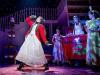
In this case, the graduating year of NIDA’s acting course under the guiding hand of French director Jean-Luc Prevost presents us with a grab-bag of scenes from Molière’s assorted classics, staged as a promenade production in which the audience follows the actors around as they present their various scenes. Upon entering, patrons are each given a cape and find themselves milling about with fully-costumed performers interacting with the audience in character, when suddenly the show starts by having a lucky (or hapless) audience member chosen to take on the role of the King. Upon his receiving a quick coronation, complete with a full ermine cloak and resplendent wig, the audience is then ushered to follow in their new King’s wake and this uproarious mobile show truly begins.
With the vast space of the NIDA building at the performers’ disposal, including the public foyers, school courtyard and even some offices (yet few of the conventional theatre venues), the audience is split up, sometimes split again and periodically re-merged into various groups of different sizes, led by the actors from place to place, viewing short scenes standing, sitting on chairs, stairs, cushions, climbing walkways, riding elevators… there is even a scene staged in the ladies toilets!
Those with a fear of being pounced on for audience interaction, or those possessing mobility issues or weak bladders (the show is about 3 hours without any interval) might want to think twice about tackling this show. For everyone else, however, the experience of following this vigorous production around should be an utter delight. The use of the space is especially clever, and the coordination involved in timing the various divisions and recombinations of the audience is an astonishing feat of stage-management. Not that it goes completely without a hitch, mind you, but that’s all part of the charm of the show’s fast-and-loose style. In one instance a cast member was delayed – as they constantly swap around from scene to scene and location to location – causing the remaining characters to improvise and play off the audience with utterly hilarious results.
This roving technique is tremendously effective: instead of the passivity of a bunch of excerpts being paraded before your eyes, instead it feels as though you are being taken to the plays while they are midway through a scene and then whisked away before they continue on any further. Not literally, of course – everything has a transparent theatricality, whereby the actors sometimes explain which particular excerpt they are performing, change character right in front of you, or occasionally yell out to each other (or invoke the director) by their real names, all whilst never dropping the almost carnivalesque sense of boisterous showmanship.
However, there is obviously more to the show than the way it has been staged, and the treatment of the texts is noteworthy. Although the default mode is one of generic Louis XIV period dress, it is all very flexible and resolutely played for highly theatrical comedy over all else, with fidelity to any particular translations or approaches to Molière being as much of a smorgasbord as the variety of episodes themselves. Some scenes contain modernised references (one even set in an office, using a modern American accent) while others happily exist in the realm of a vague period setting, and often these worlds collide as improvisation often appears to be a factor.
While the specific methods of engagement with Molière’s texts are varied, one must consider the show’s avowed overarching purpose, explicitly stated as being to ask the audience to finally decide if the work of Molière (and thus, notionally, the playwright himself) is still relevant… a question that seems rather spurious. It is a neverending annoyance that so many of our theatre practitioners feel the need to endlessly question the “relevance” of classic texts. Is there really such fear that the slightest whiff of perceived “irrelevance” will have hard-won audiences fleeing in droves? Perhaps. But perhaps our theatremakers doth protest too much.
Classics do tend to be hailed as classics for a reason, and, while it may be a clichéd explanation, enduring playwrights like Shakespeare or Molière present us with visions of the foibles and passions of humanity that really do continue to resonate, however removed we may think we are from the societies that produced these stories. For those who bemoan yet another rendition of A Midsummer Night’s Dream or The Imaginary Invalid, please consider: every production is going to be the first one someone sees, and what is old hat to you may be an exciting revelation to them.
Nevertheless, even though this production’s stated goal to explore Molière’s “relevance” seems dubious, if the actual result is as a platform for tuning new audiences on to Molière via a kind of “sampler” approach, then I couldn’t be happier. While the lack of consistent identification of which plays the plethora of scenes come from is somewhat unhelpful, it matters little, as virtually every scene is uproariously engaging, hopefully leading the uninitiated to conclude that going to see just about any Molière play would be a sure bet.
The exceptional cast and their many performances are too numerous to mention individually. Indeed, as I understand it, in a single viewing no individual patron will even get to view all of the scenes that comprise this complex production, due to the shuffling around of the groups. However, particularly memorable turns that deserve a special mention include Annabelle Stephenson, Benjamin Barber, and Rebecca Johnston, and especially the disarming Martin Harper and irrepressible Paige Gardiner, who somehow manage to be terrific team players whilst simultaneously stealing the show time after time.
While the merits of this project as an evaluation of Molière’s work may be a somewhat doubtful, there can be no question of the sheer, unadulterated joy to be had in attending A Journey Through the World of Molière. This unconventional, side-splitting show is simply brimming over with anarchic mirth, and when your jaw aches afterwards from laughing so long and hard, there’s no denying that you’ve just seen something special.
NIDA presents
A JOURNEY THROUGH THE WORLD OF MOLIÈRE
Devised and directed by Jean-Luc Prevost
Venue: NIDA Courtyard
Dates: 27 March - 4 April
Prices: Adult $25 | Concession $15 | Groups 10+ $15
Bookings: 1300 795 012 or www.ticketek.com.au
Info: www.nida.edu.au